# DECO
## Introduction
Thanks to TLS, users can access their private data securely with guarantees of end-to-end confidentiality and integrity. However, in the traditional TLS model, it is **impossible to prove this data to a third party without relying on trust assumptions**. In other words, a user’s private data remains **trapped at its origin**, with no cryptographically verifiable way to share or prove it externally.
**DECO** (**DEC**entralized **O**racle) is a protocol proposed by researchers at Cornell in 2019 that addresses this problem. It enables **privacy-preserving and selective disclosure** of data transmitted over TLS, allowing users to prove facts about their data to third parties **without revealing the underlying content**.
Moreover, DECO is the first oracle protocol to support both TLS 1.2 and TLS 1.3, making it compatible with modern web security standards **without requiring any modifications to the server**. Prior to DECO, such functionality required either **modifying the server** or relying on **Trusted Execution Environments (TEEs)**.
## Background
### ECDH (Elliptic Curve Diffie-Hellman)
**Elliptic Curve Diffie-Hellman (ECDH)** is a key exchange protocol built on **elliptic curve cryptography (ECC)**. It enables two parties to **safely derive a shared secret key** over an insecure channel using only public keys.
This is an elliptic-curve variant of the classic **Diffie-Hellman Key Exchange (DHKE)** protocol.
Let $$G$$ be a generator point on the elliptic curve:
1. **Private key generation**:\
Alice and Bob independently sample secret keys $$a, b$$.
2. **Public key computation**:
* Alice: $$A = a \cdot G$$
* Bob: $$B = b \cdot G$$
3. **Key exchange**:
* Alice sends $$A$$ to Bob.
* Bob sends $$B$$ to Alice.
4. **Shared secret key computation**:
* Alice computes $$S = a \cdot B = a \cdot (b \cdot G)$$
* Bob computes $$S = b \cdot A = b \cdot (a \cdot G)$$
Thus, both parties derive the same shared key without revealing their private inputs.
### MAC-then-Encrypt
**MAC-then-Encrypt** is the authenticated encryption approach used in **TLS 1.2 and earlier**. It ensures both **confidentiality** and **integrity** by:
1. Computing a message authentication code (MAC) with the key $$k^\mathsf{MAC}$$ and the message $$m$$:
$$
\sigma = \mathsf{MAC}(k^{\mathsf{MAC}}, m)
$$
2. Encrypting the message and MAC with the key $$k^{\mathsf{Enc}}$$:
$$
C = \mathsf{Encrypt}(k^\mathsf{Enc}, m | \sigma)
$$
To decrypt and verify $$C$$:
1. Decrypt the ciphertext:
$$
(m, \sigma) = \mathsf{Decompose(Decrypt}(k^\mathsf{Enc},C))
$$
2. Verify the MAC:
$$
\sigma \stackrel{?}= \mathsf{MAC}(k^\mathsf{MAC}, m)
$$
### HMAC (Hash-based Message Authentication Code)
**HMAC** is a type of **Message Authentication Code (MAC)** that uses a **hash function** to ensure both **integrity** and **authentication** of data.
The core idea is to **combine a cryptographic hash function with a secret key** to generate an authentication code (MAC) for a message. This allows the recipient to verify that the data has **not been tampered with** and that it was sent by a **trusted sender**.
HMAC is computed as follows:
$$
\mathsf{HMAC}(k, m) \rightarrow H((k \oplus \mathsf{opad}) | (H(k \oplus \mathsf{ipad}) | m))
$$
* $$\mathsf{opad}$$: outer padding (0x5c)
* $$\mathsf{ipad}$$: inner padding (0x36)
### AES-CBC-HMAC
**AES-CBC-HMAC** is a scheme that combines **AES encryption in CBC (Cipher Block Chaining) mode** with **HMAC-based authentication** to ensure both **confidentiality** and **integrity** of the message. It follows the **MAC-then-Encrypt** paradigm.
#### Encryption
1. Generate HMAC:
$$
\sigma = \mathsf{HMAC}(k^{\mathsf{MAC}} , m)
$$
2. Encrypt the message and MAC using AES in CBC mode:
$$
C = \mathsf{AES\text{-}CBC.Encrypt}(k^\mathsf{Enc}, m | \sigma, IV)
$$
* $$IV$$ is the **Initialization Vector**, which is sent along with the ciphertext $$C$$.
#### Decryption
1. Decrypt and split the message:
$$
(m, \sigma) = \mathsf{Decompose(AES\text{-}CBC.Decrypt}(k^\mathsf{Enc}, C, IV))
$$
2. Verify the MAC:
$$
\sigma \stackrel{?}= \mathsf{HMAC}(k^{\mathsf{MAC}} , m)
$$
TODO(chokobole): Add AES-GCM
### TLS
#### Handshake Protocol
The **TLS handshake** is the process by which a client and a server establish a secure connection. It typically involves the following steps:
1. **Cipher suite negotiation**: The client and server agree on which cryptographic algorithms (cipher suite) to use.
2. **Server authentication:** The server presents a digital certificate (usually [X.509](https://en.wikipedia.org/wiki/X.509)) to prove its identity.\
Client authentication is optional (e.g., in non-mutual TLS setups).
3. **Session key generation:** The client and server derive symmetric keys:
* $$k^{\mathsf{Enc}}$$: symmetric encryption key
* $$k^{\mathsf{MAC}}$$: symmetric authentication key
These keys are used in the following **Record Protocol** for data transmission.
DECO supports **ECDHE (Elliptic Curve Diffie-Hellman Ephemeral)** as the key exchange method.
#### Record Protocol
The **TLS Record Protocol** operates in the following steps:
1. **Data fragmentation**: The sender splits application data $$\bm{D}$$ into **fixed-size plaintext records**\
$$\bm{D} = (D\_1, D\_2, \dots, D\_n)$$. The last block $$D\_n$$ is **padded** if necessary.
2. **Optional compression**: The data may optionally be compressed before encryption.
3. **Authenticated encryption**: Each record is encrypted and authenticated using one of the following modes:
* TLS ≤ 1.2: **MAC-then-Encrypt** (e.g., AES-CBC-HMAC)
* TLS ≥ 1.3: **AEAD modes** (e.g., AES-[GCM](https://en.wikipedia.org/wiki/Galois/Counter_Mode), [ChaCha20-Poly1305](https://en.wikipedia.org/wiki/ChaCha20-Poly1305))
4. **Decryption and integrity check (receiver side)**: The receiver decrypts the record and verifies integrity by recomputing the MAC.
5. **Optional decompression and reassembly**: If compression was applied, the data is decompressed and multiple records are combined to reconstruct the original application data.
DECO supports both **CBC-HMAC** and **GCM mode** for AES-based encryption.
## Protocol Explanation
```json
{
"accounts": [
{ "account_id": 1, "balance": 500 },
{ "account_id": 2, "balance": 2000 },
{ "account_id": 3, "balance": 5000 }
]
}
```
Let’s assume the above JSON message was received from a bank server over TLS. Our goal is to prove in zero-knowledge (ZK) that the account with `account_id = 2` has a balance greater than or equal to 1000, without revealing any information about the other accounts.
For simplicity, we assume that the TLS session uses **AES-CBC-HMAC** (as in TLS 1.2), though this can be extended to **AES-GCM** as well.
TODO(chokobole): Add how DECO is instantiated with AES-GCM
### Method 1: Naive Approach
The most straightforward idea is to construct a circuit like the one below and generate a ZK proof.\
(We omit **AES-CBC's** IV for clarity.)
$$
C(x: { C, q }, w: { k^\mathsf{Enc}, k^\mathsf{MAC}, m }) : \ \sigma \stackrel{?}= \mathsf{HMAC}(k^{\mathsf{MAC}} , m) \land C \stackrel{?}= \mathsf{AES\text{-}CBC.Encrypt}(k^\mathsf{Enc}, m | \sigma) \land \mathsf{jq.exec}(m, q) \ge 1000
$$
Here, we use the notation from [the circuit overview](https://fractalyze.gitbook.io/intro/~/revisions/GBuVDfZJZBNDtoleSgnx/application/zktls/broken-reference).
* $$q$$ is the [jq](https://jqlang.org/) query: `.accounts[] | select(.account_id == 2) | .balance`
* $$\mathsf{jq.exec}(m, q)$$ denotes applying the jq query $$q$$ to message $$m$$
#### ❗ Problem
This naive approach has a critical security flaw: **The client already knows the MAC key** $$k^{\mathsf{MAC}}$$.
This means the client can **forge a valid MAC for a tampered message**. For example, even if the real balance is only 500, the client could create a fake message like:
```json
{
"accounts": [
{ "account_id": 1, "balance": 500 },
{ "account_id": 2, "balance": 9999 },
{ "account_id": 3, "balance": 5000 }
]
}
```
and generate a valid MAC on it—making it appear as though the server authenticated this falsified message.
Thus, performing MAC verification entirely inside the ZK circuit **fails to prevent forgery when the client knows the MAC key**.
### Method 2: Three-Party Handshake
The limitation of the naive approach lies in the fact that, under the standard TLS model, the **client learns the MAC key** $$k^{\mathsf{MAC}}$$ **before receiving the server’s response** $$R$$.
Because the client directly knows the MAC key, it can **forge a message and still generate a valid ZK proof**, introducing a serious vulnerability.
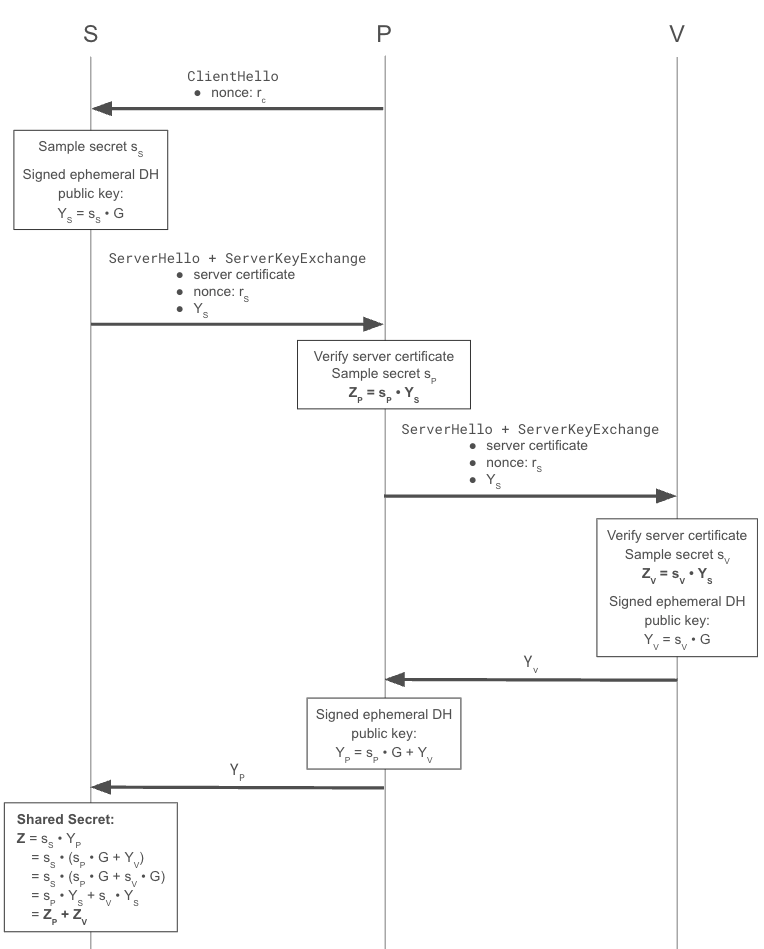
To resolve this, **DECO introduces a Three-Party Handshake** involving:
* $$\mathcal{P}$$: TLS client and ZK prover
* $$\mathcal{V}$$: Verifier
* $$\mathcal{S}$$: TLS server
#### :bulb: Core Idea
* The **MAC key** $$k^{\mathsf{MAC}}$$ is split between $$\mathcal{P}$$ and $$\mathcal{V}$$, so that $$\mathcal{P}$$ **cannot compute it alone**.
* $$\mathcal{P}$$ first **commits** to the received TLS message.
* Only then does $$\mathcal{V}$$ reveal their MAC key share, preventing the prover from tampering with the message (At this moment, $$\mathcal{P}$$ and $$\mathcal{V}$$ know the full MAC key $$k^\mathsf{MAC}$$).
#### Step 1: Key Exchange
#### Step 2: Key Derivation
*TODO(chokobole): Add details on how the MAC key is derived from the shared secrets* $$Z\_\mathcal{P}$$* and* $$Z\_\mathcal{V}$$*.*
#### ❗ Problem
In **Method 1**, the prover $$\mathcal{P}$$ knows the full MAC key $$k^{\mathsf{MAC}}$$, allowing them to compute HMAC and all related operations **locally**.
However, from **Method 2 onward**, the MAC key is only **additively shared** between $$\mathcal{P}$$ and $$\mathcal{V}$$, meaning:
* $$\mathcal{P}$$ cannot reconstruct the full key.
* **HMAC must be computed via a Two-Party MPC (2PC)** protocol. In order to send a query, the prover $$\mathcal{P}$$ and the verifier $$\mathcal{V}$$ compute the MAC together as follows(We use the notation defined in [here](https://fractalyze.gitbook.io/intro/~/revisions/GBuVDfZJZBNDtoleSgnx/introduction/notations-and-definitions/mpc#n-party-mpc)) :
$$
\mathsf{MPC}*2(\mathsf{HMAC}, k^\mathsf{MAC}*\mathcal{P}, k^\mathsf{MAC}*\mathcal{V}, m) \rightarrow \mathsf{HMAC}(k^\mathsf{MAC}*\mathcal{P} + k^\mathsf{MAC}\_\mathcal{V}, m)
$$
This introduces a performance challenge: **Naively computing HMAC via 2PC is expensive**, as HMAC internally invokes the hash function **twice**, each requiring complex boolean circuits with a high gate count.
### Method 3: Query Optimization
Now in order to send a query, the prover $$\mathcal{P}$$ and the verifier $$\mathcal{V}$$ compute the MAC together as follows:
To address the performance bottleneck in Method 2, Method 3 applies an **optimization strategy that leverages the structural properties of HMAC and the internal workings of SHA-256**.
The goal is to **minimize the scope of 2PC computations** by offloading as much of the work as possible to local computation.
$$
\mathsf{HMAC}(k, m) \rightarrow \underbrace{H((k \oplus \mathsf{opad}) | \underbrace{H\left((k \oplus \mathsf{ipad}) | m\right)}*{\text{inner hash}})}*{\text{outer hash}}
$$
SHA-256 follows the [Merkle–Damgård](https://en.wikipedia.org/wiki/Merkle%E2%80%93Damg%C3%A5rd_construction) construction, processing messages in blocks. It computes hashes in the following recursive manner:
$$
H(m\_1 | m\_2) = f\_H(f\_H(IV, m\_1), m\_2)
$$
where:
* $$f\_H$$ is the compression function of the hash
* $$IV$$ is the initial vector.
Using this structure, HMAC can be split and optimized as follows:
1. **Initial compression via 2PC**:
$$
s\_0 = f\_H(IV, k \oplus \mathsf{ipad})
$$
2. **Compute inner hash locally**:
$$
s\_1 = H(s\_0 | m)
$$
As $$s\_0$$ is already known, the prover $$\mathcal{P}$$ can compute the **inner hash** $$s\_1$$ locally using the full message $$m$$.
3. **Compute outer hash via 2PC only**:
$$
\mathsf{MPC}*2(\mathsf{HMAC\text{-}opt}, k^\mathsf{MAC}*\mathcal{P}, k^\mathsf{MAC}*\mathcal{V}, s\_1) \rightarrow \mathsf{HMAC\text{-}opt}(k^\mathsf{MAC}*\mathcal{P} + k^\mathsf{MAC}\_\mathcal{V}, s\_1)
$$
where $$\mathsf{HMAC\text{-}opt}$$ is defined as:
$$
\mathsf{HMAC\text{-}opt}(k, s\_1) = H((k \oplus \mathsf{opad}) | s\_1)
$$
By computing the most expensive part of the computation (inner hash) locally, this optimization significantly reduces the cost of 2PC.
### Method 4: AES-CBC-HMAC Optimization
As in Method 1, verifying the entire AES-CBC-HMAC process **inside a ZK circuit introduces significant computational overhead**. To address this, we can apply a circuit-level optimization that leverages the **CBC** structure and **MAC-then-Encrypt** semantics.
Assume that the message $$m$$ consists of 1024 AES blocks, and the MAC $$\sigma$$ consists of 3 fixed-size AES blocks:
$$
\bm{M} = (B\_1, \dots, B\_{1024}, \sigma), \quad \bm{\sigma} = (B\_{1025}, B\_{1026}, B\_{1027})
$$
After **CBC** encryption, it transforms into:
$$
\hat{\bm{M}} = (\hat{B}*1, \dots, \hat{B}*{1024}, \hat{\sigma}), \quad \bm{\hat{\sigma}} = (\hat{B}*{1025}, \hat{B}*{1026}, \hat{B}\_{1027})
$$
If we naively construct the circuit, we would need to perform **1027 AES encryptions inside the circuit**:
$$
C(x: { \bm{\hat{M}} }, w: { k^\mathsf{Enc}, \bm{M} }) : \bigwedge\_{i=1}^{1027} \hat{B}\_i \stackrel{?}= \mathsf{AES\text{-}CBC.Encrypt}(k^\mathsf{Enc}, B\_i)
$$
#### Optimization 1: Verifying MAC Blocks Only
Using the MAC-then-Encrypt structure, we can **only verify the MAC portion of the CBC-encrypted message** in the circuit. The HMAC itself can be checked outside the circuit:
$$
C(x: { \textcolor{red}{\bm{\sigma}, \bm{\hat{\sigma}}} }, w: { k^\mathsf{Enc} }) : \textcolor{red}{\bigwedge\_{i=1025}^{1027}}\hat{B}\_i \stackrel{?}= \mathsf{AES\text{-}CBC.Encrypt}(k^\mathsf{Enc}, B\_i)
$$
Then the verifier $$\mathcal{V}$$ checks the HMAC externally:
$$
\sigma \stackrel{?}= \mathsf{HMAC}(k^\mathsf{MAC}, m)
$$
This is secure under the assumption that HMAC is collision-resistant.
#### Optimization 2: Include Only Sensitive Block in the Circuit
If the $$i$$-th block (where $$i \in \[1024]$$) contains sensitive data, we can selectively include it in the circuit:
$$
C(x: { \bm{\sigma}, \bm{\hat{\sigma}}, \textcolor{red}{\bm{B\_{i-}}, \bm{B\_{i+}}} }, w: { k^\mathsf{Enc}, \textcolor{red}{k^{\mathsf{MAC}}, B\_i} }) : \ \bigwedge\_{j=1025}^{1027} \hat{B}*j \stackrel{?}= \mathsf{AES\text{-}CBC.Encrypt}(k^\mathsf{Enc}, B\_j) \land \textcolor{red}{\sigma \stackrel{?}= \mathsf{HMAC}(k^\mathsf{MAC}, \bm{B*{i-}}|B\_i|\bm{B\_{i+}})}
$$
Where:
* $$\bm{B\_{i-}} = (B\_1, \dots, B\_{i-1})$$
* $$\bm{B\_{i+}} = (B\_{i+1}, \dots, B\_{1024})$$
#### Optimization 3: Apply HMAC Optimization from Method 3
We can further reduce the circuit by applying the HMAC optimization described in Method 3:
$$
C(x: { \bm{\sigma}, \bm{\hat{\sigma}}, \textcolor{red}{s\_{i-1}, s\_i} }, w: { k^\mathsf{Enc}, B\_i }) : \ \bigwedge\_{j=1025}^{1027} \hat{B}*j \stackrel{?}= \mathsf{AES\text{-}CBC.Encrypt}(k^\mathsf{Enc}, B\_j) \land \textcolor{red}{s\_i \stackrel{?}= f\_H(s*{i-1}, B\_i)}
$$
Then, outside the circuit:
1. Compute $$s\_{i-1} = H(\bm{B\_{i-}})$$
2. Verify $$s\_{i-1} \stackrel{?}{=} x.s\_{i-1}$$
3. Verify $$\sigma \stackrel{?}{=} H((k \oplus \mathsf{opad}) | H(s\_i | \bm{B\_{i+}}))$$
#### Final Circuit Structure
$$
C(x: { \textcolor{red}{\bm{\sigma}, \bm{\hat{\sigma}}, s\_{i-1}, s\_i} }, w: { k^\mathsf{Enc}, \textcolor{red}{B\_i} }) : \ \textcolor{red}{\bigwedge\_{j=1025}^{1027} \hat{B}*j \stackrel{?}= \mathsf{AES\text{-}CBC.Encrypt}(k^\mathsf{Enc}, B\_j) \land s\_i \stackrel{?}= f\_H(s*{i-1}, B\_i) \land \mathsf{extractBalance(}B\_i) \ge 1000}
$$
#### ❗ Problem
However, there's still a critical issue: **How do we know that** $$B\_i$$** actually corresponds to the field we intend to prove?**
For example, if we're trying to prove the balance of `account_id = 2`, there's nothing in the above circuit that guarantees $$B\_i$$ isn't actually from account 1 or 3.
Thus, we need an additional mechanism to ensure:
* **Context Integrity** — the value is taken from the correct location
### Method 5: Context Integrity via Structured Commitments
This method is based on the [Chainlink blog post on DECO](https://blog.chain.link/deco-parsing-the-response/#soundness_checks) and aims to resolve a key limitation identified in Method 4—namely, **the inability to verify that a block truly corresponds to the intended field**.
To address this, the prover $$\mathcal{P}$$ constructs a sanitized version of the TLS response message $$R$$, denoted $$R'$$, where **sensitive data fields are removed**.
For example, suppose the original message looks like this:
```json
{
"accounts": [
{ "account_id": "", "balance": "" },
{ "account_id": "", "balance": "" },
{ "account_id": "", "balance": "" }
]
}
```
The actual values that were removed are committed separately as a vector of scalars:
$$
Z = (1, 500, 2, 2000, 3, 5000)
$$
#### Verification Process
The verifier proceeds as follows:
Each $$Z\_k$$ represents a redacted numeric value from the response, and the remaining static content is encoded as a list of **fixed string tokens** $$P$$, representing the prefix/suffix structure of the original JSON:
```json
P = [
"{\n \"accounts\": [\n { \"account_id\": ",
", \"balance\": ",
" }, \"account_id\": ",
", \"balance\": ",
" }, \"account_id\": ",
", \"balance\": ",
"}\n ]}"
]
```
Using this setup, the verifier $$\mathcal{V}$$ checks the following conditions:
1. $$R'$$ is a syntactically valid JSON.
2. The following circuit holds:
$$
C(x: { \[P\_k]*{0 \le k \le n}, \[Z\_k]*{0 \le k < n}, \[R] }, w: { {Z\_k}*{0 \le k < n} }) : \\
\[R] \stackrel{?}= \[P\_0 | Z\_0 | \dots |P*{n-1}|Z\_{n-1}|P\_n] \land \bigwedge\_{k=0}^{n-1} \[Z\_k] \stackrel{?}= \mathsf{Commit}(Z\_k)
$$
* $$\[X]$$: commitment of $$X$$
* The commitment scheme used must support **homomorphism under string concatenation**.
In the above example, $$Z\_3$$ corresponds to the balance for `account_id = 2`, solving the ambiguity issue from [Method 4](#method-4-aes-cbc-hmac-optimization).
*TODO(chokobole): Add details on commitment schemes that support this homomorphic property.*
#### Forgery Prevention Examples
If a malicious prover tampers with the response structure, the verification fails due to a **mismatch in the number of commitments or string layout**:
❌ **Missing fields**
```json
{
"accounts": [
{ "account_id": "", "balance": "" },
{ "account_id": "", "balance": "" }
]
}
```
❌ **Sensitive data not redacted**
```json
{
"accounts": [
{ "account_id": 1, "balance": 500 },
{ "account_id": "", "balance": "" },
{ "account_id": "", "balance": "" }
]
}
```
#### Final Circuit Structure
$$
C(x: { \bm{\sigma}, \bm{\hat{\sigma}}, s\_{i-1}, s\_i, \textcolor{red}{{\[P\_k]}*{0 \le k \le n}, {\[Z\_k]}*{0 \le k < n}, \[R], Z\_m} }, w: { k^\mathsf{Enc}, B\_i, \textcolor{red}{{Z\_k}*{0 \le k < n}} }) : \ \bigwedge*{j=1025}^{1027} \hat{B}*j \stackrel{?}= \mathsf{AES\text{-}CBC.Encrypt}(k^\mathsf{Enc}, B\_j) \land s\_i \stackrel{?}= f\_H(s*{i-1}, B\_i) \land \textcolor{red}{\mathsf{isCorrectBlock}(B\_j, Z\_m) \land \[R] \stackrel{?}= \[P\_0 | Z\_0 | \dots |P\_{n-1}|Z\_{n-1}|P\_n] \land \bigwedge\_{k=0}^{n-1} \[Z\_k] \stackrel{?}= \mathsf{Commit}(Z\_k) \land Z\_m \ge 1000}
$$
* $$m$$: the expected index of the scalar vector $$\bm{Z}$$.
*TODO(chokobole): The paper and Chainlink blog do not provide detailed implementation of how* $$\mathsf{isCorrectBlock}$$ *is constructed.*
## Conclusion
**DECO** enables **verifiable web data disclosure**, a capability that traditional TLS protocols do not support. It overcomes the inherent limitation of web data being **"private-by-design" and trapped at the origin**, using zero-knowledge proofs (ZK).
Its core contributions are as follows:
* Through a **Three-Party Handshake** architecture, DECO **securely splits the TLS session key (especially the MAC key)** between the prover $$\mathcal{P}$$ and verifier $$\mathcal{V}$$, preventing the prover from forging TLS responses.
* It is designed to **verify both TLS message integrity and application-level data predicates inside a ZK circuit**, enabling selective and private disclosure.
* DECO leverages the [**Merkle–Damgård**](https://en.wikipedia.org/wiki/Merkle%E2%80%93Damg%C3%A5rd_construction) **structure of SHA-256**, the **MAC-then-Encrypt construction**, and **parsing-aware validation techniques** to minimize 2-Party Computation (2PC) overhead and optimize ZK proof efficiency.
* The **context integrity** problem for DECO is solved through grammar-aware parsing and enabling **position binding** proofs in ZK—for example, proving a specific value comes from a structured key-value JSON field without revealing the entire context.
## References
*
*
*
*
*
> Written by [Ryan Kim](https://app.gitbook.com/u/cPk8gft4tSd0Obi6ARBfoQ16SqG2 "mention") of Fractalyze